-1.png)

Polycarbonate combines glass-like optical clarity with toughness that glass simply doesn't have, which is why it ends up in everything from automotive headlamp lenses to medical device housings. It's also one of the more demanding materials to mold correctly. Moisture control isn't a nice-to-have with PC; skip it and the part degrades from the inside before it ever shows a visible defect.
This guide covers PC's core property profile, how to navigate its grade ladder, the processing window that keeps it from degrading, and the mold design choices that determine whether a transparent PC part actually looks transparent.
Property Profile: What Makes PC Different
PC is an amorphous thermoplastic, which sets it apart from semi-crystalline materials like nylon or PP in both its optical behavior and its shrinkage pattern.
Heat Resistance and Dimensional Stability
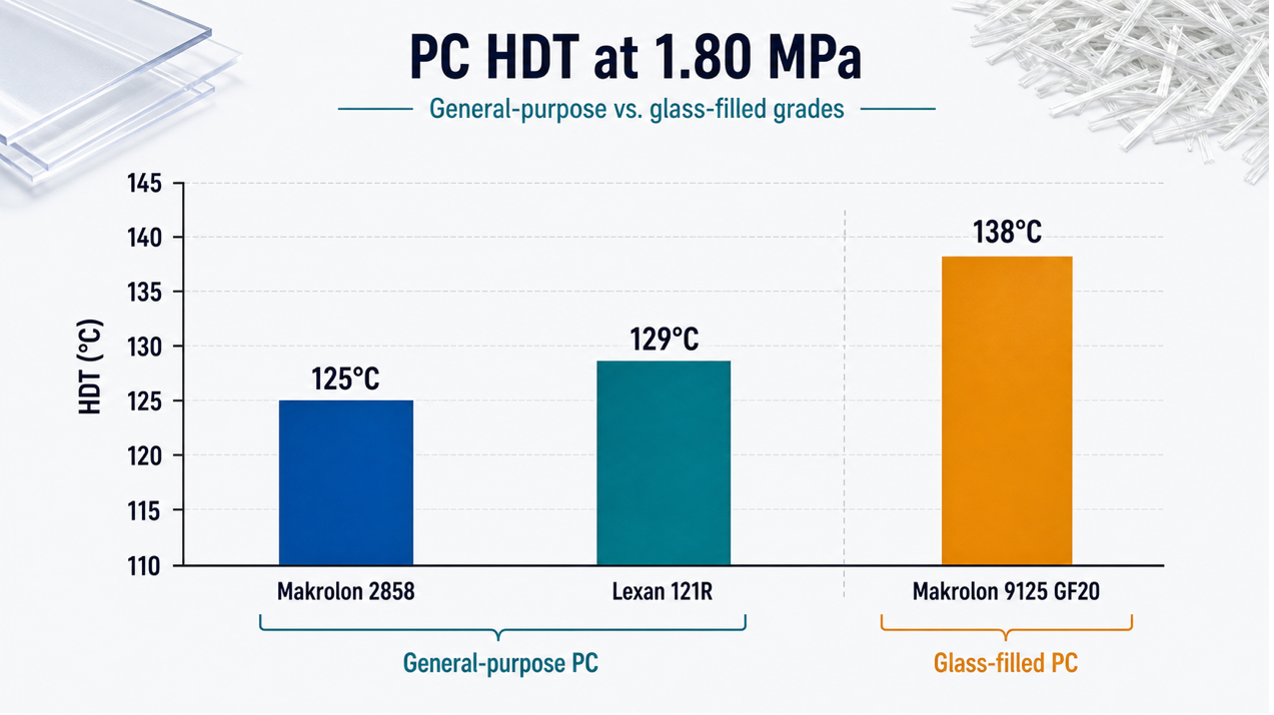
A general-purpose medical-grade Makrolon resin (Makrolon 2858) shows a glass transition temperature of 145°C, with heat deflection temperature (HDT) of 125°C at 1.80 MPa and 137°C at 0.45 MPa [1]. An independent cross-check against SABIC's competing Lexan 121R general-purpose grade shows a similar HDT profile: 129°C at 1.80 MPa and 137°C at 0.46 MPa [2], confirming this heat resistance range isn't specific to one manufacturer's formulation. Adding glass fiber pushes HDT higher still; a 20%-glass-filled, flame-retardant Makrolon grade (Makrolon 9125) shows HDT climbing to 138°C at 1.80 MPa and 142°C at 0.45 MPa [3].
Optical Clarity, by the Numbers
The same Makrolon 2858 datasheet lists luminous transmittance of 89% [1], and SABIC's Lexan 121R shows a closely matching 88% visible transmission at 2.54mm thickness [2]. That's close enough to glass that PC is the default choice whenever a part needs to be both transparent and impact-resistant, since glass simply can't match PC's toughness at equivalent thickness.
The Moisture Trade-Off
PC absorbs moisture readily for an engineering plastic. Makrolon 2858's datasheet lists water absorption of 0.3% with a humidity-equilibrium value of 0.12% [1], while SABIC's Lexan 121R shows 0.15% water absorption at 24 hours and 0.35% at moisture equilibrium [2]. The two independent datasheets land in the same range, and that absorbed moisture is the root cause of nearly every PC-specific processing defect, because at melt temperature it reacts with the polymer chain and breaks it down rather than simply evaporating harmlessly.
Quick property snapshot (general-purpose grades, two independent sources)
|
Property |
Makrolon 2858 (Covestro) |
Lexan 121R (SABIC) |
|
Glass transition temperature |
145°C [1] |
— |
|
HDT, 1.80 MPa |
125°C [1] |
129°C [2] |
|
HDT, 0.45 MPa |
137°C [1] |
137°C (0.46 MPa) [2] |
|
Luminous transmittance |
89% [1] |
88% [2] |
|
Water absorption (saturation/24h) |
0.3% [1] |
0.15% (24h) [2] |
|
Water absorption (equilibrium) |
0.12% [1] |
0.35% [2] |
|
Tensile modulus / strength at break |
— |
68 MPa at break [2] |
Grade Selection Map
Choosing the right PC grade matters more than choosing the right base resin, since PC's grade portfolio spans very different performance envelopes.
General Purpose and Flame-Retardant Grades
General-purpose grades cover most enclosures and structural parts that don't need optical clarity or extreme heat resistance. Flame-retardant grades add UL94 V-0 or V-2 ratings; the glass-filled flame-retardant grade referenced above (Makrolon 9125) carries a UL94 V-0 rating at 1.5mm and an oxygen index of 35% [3].
Glass-Filled Grades for Stiffness
Glass-fiber-reinforced PC trades transparency for stiffness. Makrolon 9125, a 20%-glass-filled grade, shows a tensile modulus of 5,800 MPa and stress at break of 85 MPa [3], compared to general-purpose unfilled PC, which typically falls in the 2,200-2,400 MPa tensile modulus range. The cost is impact strength: Makrolon 9125's Charpy impact strength is 40 kJ/m² at 23°C [3], notably lower than unfilled PC grades, so glass fiber is a stiffness-for-toughness trade, not a free upgrade.
UV-Stabilized, Medical, and Optical Grades
UV-stabilized grades protect against outdoor yellowing. Medical grades are validated for ETO and steam sterilization; Makrolon 2858 specifically carries ISO 10993 biocompatibility certification and is suited to ETO and steam sterilization at 121°C [1]. Optical lens and light-guide grades are formulated for the highest achievable light transmission and are the right starting point for any application where clarity is the primary spec, not an afterthought.
Processing Essentials
Drying Is the First Process Step, Not an Afterthought
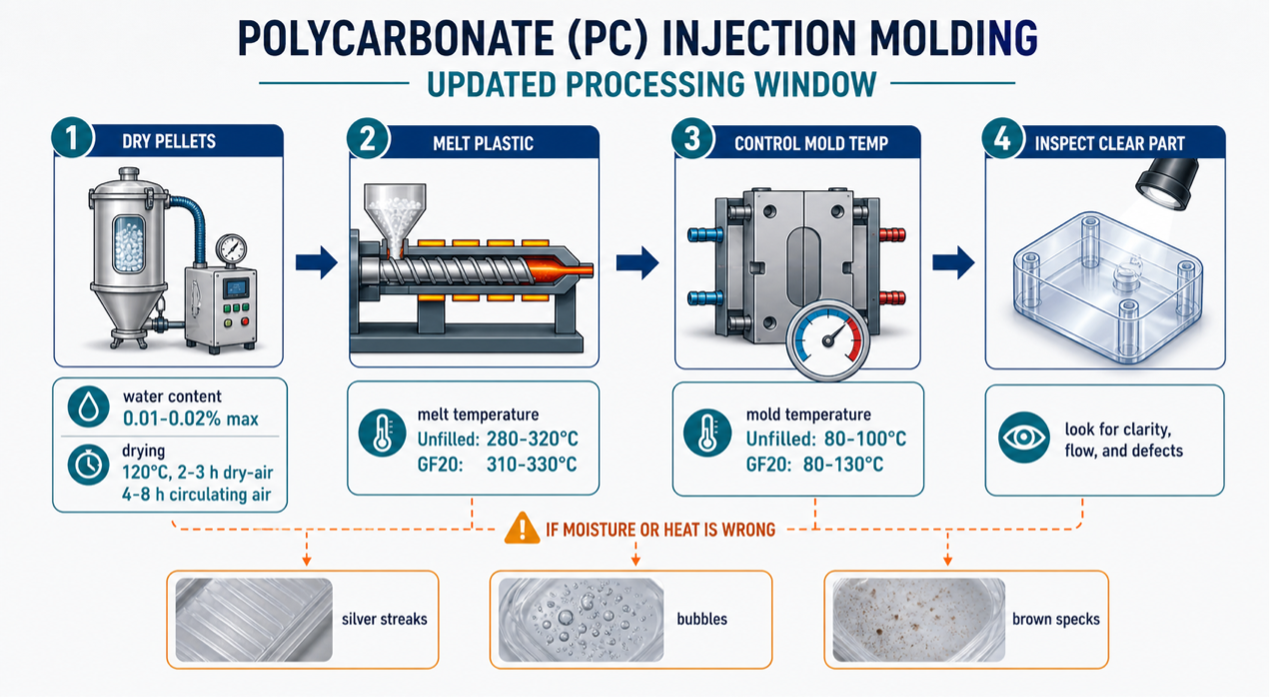
Makrolon 2858's processing guidance specifies a maximum water content of 0.01-0.02% before molding, with pre-drying at 120°C for 2-3 hours in a dry-air dryer, or up to 4-8 hours in a circulating air oven [1]. The glass-filled Makrolon 9125 grade carries the same 0.01-0.02% moisture ceiling and similar drying time ranges [3]. Skipping this step doesn't just risk surface defects; it reduces molecular weight in ways that can't be reversed by any downstream process step.
Melt Temperature and Injection Speed
Makrolon 2858 specifies a melt temperature of 280-320°C for unfilled, general-purpose PC [1], while the glass-filled Makrolon 9125 grade runs hotter at 310-330°C [3]. Medium injection speed is generally appropriate; PC's high melt viscosity means pushing speed too far raises shear heating right when the priority should be filling without adding the stress that leads to cracking later.
Mold Temperature: Higher for Optical Parts
Makrolon 2858's recommended mold temperature is 80-100°C [1], while the glass-filled Makrolon 9125 grade widens that range to 80-130°C [3]. For optical-clarity parts specifically, the higher end of the unfilled grade's range reduces frozen-in stress that would otherwise show up as visible birefringence under polarized light.
Mold Design Considerations
Surface Finish and Draft
Polished cavity surfaces are essential for transparent parts, since any tooling marks or texture transfer directly to a part the end user will look through. PC generally needs more draft than easily-released amorphous resins; insufficient draft on a transparent part risks drag marks that are far more visible than on an opaque part of the same geometry.
Venting to Prevent Burn Marks
Adequate venting matters more for PC than for many resins because its higher melt viscosity and processing temperature mean trapped air ignites more readily under compression, producing burn marks at the end of fill. Vents sized for a lower-viscosity material will often be undersized for PC.
Hot Runners Pay for Themselves
PC's relatively high cost per kilogram makes cold-runner scrap expensive across a production run. Hot runner systems are commonly justified specifically for PC tooling even on programs where a cheaper resin wouldn't justify the upfront tooling cost.
Applications and Troubleshooting
|
Industry |
Typical PC application |
|
Automotive |
Headlamp lenses, interior trim |
|
Electronics |
Laptop housings, connectors |
|
Medical |
Surgical instruments, clear device housings |
Reading PC's Most Common Surface Defects
Silver streaks point to moisture in the melt almost every time. Bubbles can come from either moisture or overheating, so the troubleshooting sequence should rule out drying first since it's the more common root cause. Brown specks indicate thermal degradation, usually from excessive residence time or melt temperature creeping above the recommended window.
Stress Cracking: The Defect That Shows Up Later
Stress cracking from overpacking or sharp internal corners often doesn't appear until the part is in service, sometimes weeks or months after molding, which makes it the most expensive PC defect category to catch late. Designing out sharp corners during the part design phase costs nothing. Discovering stress cracking after tooling is cut costs a redesign and a re-cut.
Getting Optical-Grade PC Parts Right
PC's processing demands, especially the pre-drying discipline and mold temperature control covered above, are exactly where an experienced molding partner earns its keep. HordRT works with general-purpose, glass-filled, and medical-grade PC as part of our plastic injection molding services, with particular attention to moisture validation and mold temperature control on optical-clarity and medical parts where contamination and surface defects aren't acceptable.
Conclusion
PC rewards careful processing with part performance that's hard to match in any other transparent thermoplastic. Two habits make the difference: dry it thoroughly to the moisture spec, and design out sharp corners before steel is cut. Get those two things right, and PC delivers the combination of clarity, toughness, and heat resistance that few other materials can offer at the same time.
Sources
- Covestro Deutschland AG. "Makrolon® 2858 Technical Datasheet." Material Data Center (CAMPUS plastics data bank). https://www.materialdatacenter.com/ms/en/tradenames/Makrolon/Covestro+Deutschland+AG/Makrolon%C2%AE+2858/d87de626/410
- SABIC Innovative Plastics. "Lexan® 121R PC Datasheet." Data sourced via UL Prospector. https://www.lookpolymers.com/polymer_SABIC-Innovative-Plastics-Lexan-121R-PC.php
- Covestro Deutschland AG. "Makrolon® 9125 (PC-GF20) Technical Datasheet." Distributed via Albis Plastic. https://www.albis.com/en/products/download/doc/en/SI/covestro/Makrolon9125.pdf