-1.png)

A low dryer dew point is useful process data, but it is not a moisture result for the pellets entering the barrel. The dryer can deliver suitably dry air while the resin receives too little heat, spends too little time in the hopper, moves through an uneven airflow pattern, or reabsorbs moisture during transfer. In each case, the dryer display may look acceptable while the resin is not.
The consequence also depends on the exact polymer and grade. Moisture can flash into vapor and mark a surface, or it can participate in hydrolysis at melt temperature and reduce molecular weight. The first problem may be corrected before the material is processed. The second is permanent once the polymer chains have been cut. Effective resin drying in injection molding therefore requires two decisions: prove the pellets meet the grade-specific moisture limit before melting, then determine whether any suspect material has already suffered irreversible damage.
Separate a Moisture Symptom From Polymer Damage
Moisture-related streaks and bubbles are visible effects of water vapor or other volatiles moving through the melt. They justify an investigation, but appearance alone does not identify the volatile or prove that the polymer has hydrolyzed. Venting, contamination, excessive shear, and thermal degradation can produce similar-looking defects.
Hydrolysis is different. In its Makrolon WB1239 guide, Covestro explains that residual water can produce streaks or small bubbles at processing temperature and can also break polycarbonate molecular chains, lowering molecular weight and potentially mechanical performance. Once wet resin has been melted and hydrolyzed, drying the pellets or molded parts later cannot rebuild those chains. [1]
Eastman's guide for two Tritan Renew copolyester grades uses intrinsic-viscosity retention to assess processing damage and states grade-specific pellet-moisture limits. It also connects molecular weight with tensile, impact, creep, and chemical-resistance behavior. A visually acceptable part is therefore not sufficient evidence that a hydrolysis-sensitive resin retained its original material state. [2]
| Material example | What the cited supplier says about moisture | Can drying recover the material? |
|---|---|---|
| Makrolon WB1239 polycarbonate | Residual moisture can cause streaks or bubbles and hydrolytic molecular-weight loss at processing temperature. [1] | Unmelted pellets can be dried to the grade specification; molecular-weight loss after wet melting is not reversed by drying. |
| Tritan Renew copolyester grades in the cited guide | The guide specifies a maximum pellet-moisture condition and uses intrinsic-viscosity loss as a processing-quality indicator. [2] | Drying protects unprocessed pellets; unacceptable intrinsic-viscosity loss requires a material disposition decision, not another drying cycle. |
| Ultramid B3WG3 BK23274, PA6-GF15 | BASF lists 0.03-0.06% recommended moisture, 80°C dryer temperature, and four hours as grade-specific processing data, with drying time dependent on initial moisture and dry-air dew point. [3] | Dry to this grade's specification before processing; the data sheet does not support transferring the same values to every nylon. |
| Standard and toughened Delrin grades | The current Delrin guide says standard grades generally do not require drying, then defines exposure conditions that do require it; toughened grades have a separate moisture limit and schedule. [4] | Follow the exact grade guidance. POM should not be grouped automatically with hydrolysis-sensitive PC, PA, or polyester. |
The table is deliberately not a universal drying chart. A polymer-family name does not define the commercial grade, filler, additive package, incoming condition, or supplier's current instructions. The processing data sheet for the material on the purchase order is the controlling reference.
Separate Drying Categories Without Turning Them Into Family Rules
"Hygroscopic" and "non-hygroscopic" are useful first classifications, not complete work instructions. Surface condensation, poor storage, additives, fillers, regrind, and a supplier-specific compound can change the required handling even when the base polymer name stays the same.
| Material category | Defensible starting logic | What must be verified |
|---|---|---|
| PP or PE polyolefin | LyondellBasell describes polyolefins as non-hygroscopic, so virgin material in protected storage does not normally use the same desiccant-drying logic as PC, PA, or polyester. [9] | Check the exact compound, condensation or surface moisture, filler/additive instructions, regrind exposure, and any supplier-required conditioning. |
| ABS | INEOS Styrolution states that unfavorable storage or transport can leave enough moisture in its Terluran GP-22 grade to cause visible surface faults and gives grade-specific predrying guidance. [10] | Do not copy the published GP-22 limit or schedule to another ABS grade; use the purchased grade's current record. |
| General-purpose PS | INEOS Styrolution states that the cited GPPS grade does not normally need predrying for injection molding, while outdoor-hopper storage can justify it. [11] | Separate normal processing from condensation or adverse storage, and confirm the actual grade and process. |
| PMMA molding compound | Do not inherit the PS or ABS rule merely because all three are amorphous materials. | Obtain the exact producer's moisture limit, drying temperature/time, allowed residence, and optical-surface requirements; leave the instruction unresolved until that grade record is available. |
POM Moisture Control Is Not Formaldehyde Exposure Control
The current Delrin guide says standard grades generally do not require drying and do not follow the same melt-hydrolysis mechanism as PC or polyester. Moisture above its stated condition can still create surface defects, and toughened grades have separate drying requirements. By contrast, the guide's decomposition warning focuses on excessive melt temperature or residence time, material hold-up, and incompatible contamination; decomposition can release gaseous formaldehyde. [4]
Treat an unusual odor, gas evolution, or pressure behavior as a safety event governed by the current supplier safety data and the site's emergency procedure. Provide effective local exhaust ventilation, prevent incompatible resin contamination, control melt temperature and residence time, and account for the possible effect of decomposition products on people and equipment. Do not describe drying alone as a formaldehyde or corrosion control, and do not claim that "wet POM" universally accelerates decomposition without grade-specific evidence. [4]
Four Variables Must Work Together
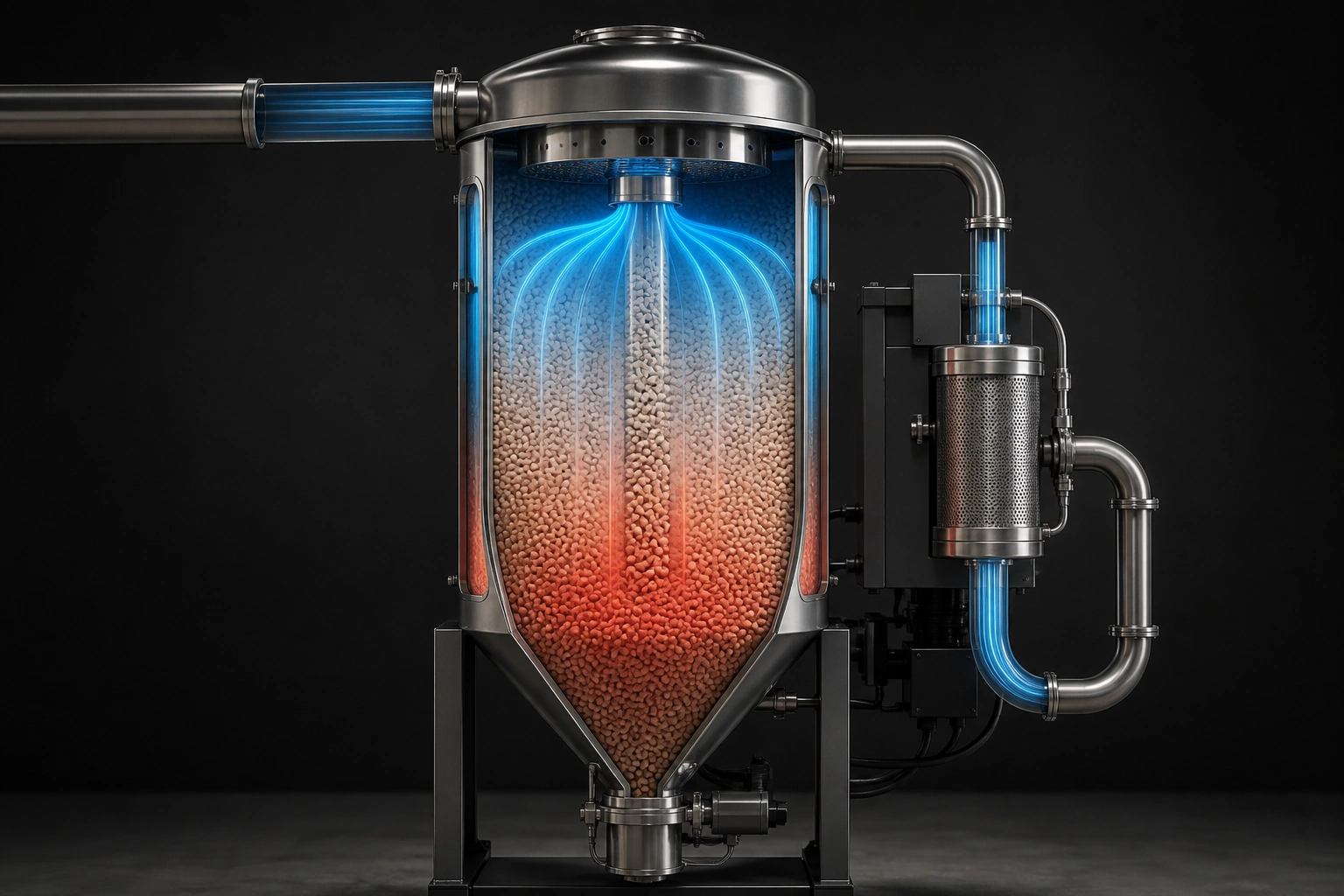
Drying is a mass-transfer process. A target is reached only when dry air, heat, time, and airflow work together for the actual resin load.
Dew Point Controls the Drying Potential of the Air
Dew point describes the water content of the drying air. It helps show whether the desiccant system can supply air capable of carrying more moisture away, but it does not directly report the remaining water in a pellet. A lower number is not an independent product specification; it must be paired with the resin supplier's temperature, time, and moisture limit.
Temperature Drives Moisture From the Pellet
Pellet temperature must be high enough for moisture to diffuse toward the surface, yet remain within the supplier's limit for sticking, oxidation, additive change, or other degradation. Copying a temperature from another grade is unsafe even within one resin family. The cited BASF PA6-GF15 sheet, for example, warns that excessive drying may raise melt viscosity. [3]
Residence Time Depends on Throughput
The relevant time is not how long the dryer has been switched on. It is the time each portion of resin spends at the required condition. A first estimate is usable hopper mass divided by material throughput, but funnel flow, short-circuiting, refill strategy, and a changing production rate can make actual residence less uniform. AEC advises sizing the hopper from throughput and required drying time rather than assuming every pellet receives the timer setting. [5]
Airflow Distributes Heat and Removes Moisture
Air must reach the bed uniformly, deliver heat, and carry released moisture away. Too little or poorly distributed flow can leave zones below temperature even when the supply-air reading is correct. Eastman's guide treats dew point, temperature, drying time, airflow, and hopper sizing as a connected system, not interchangeable settings. [2]
Prove Moisture Content at the Last Controlled Point
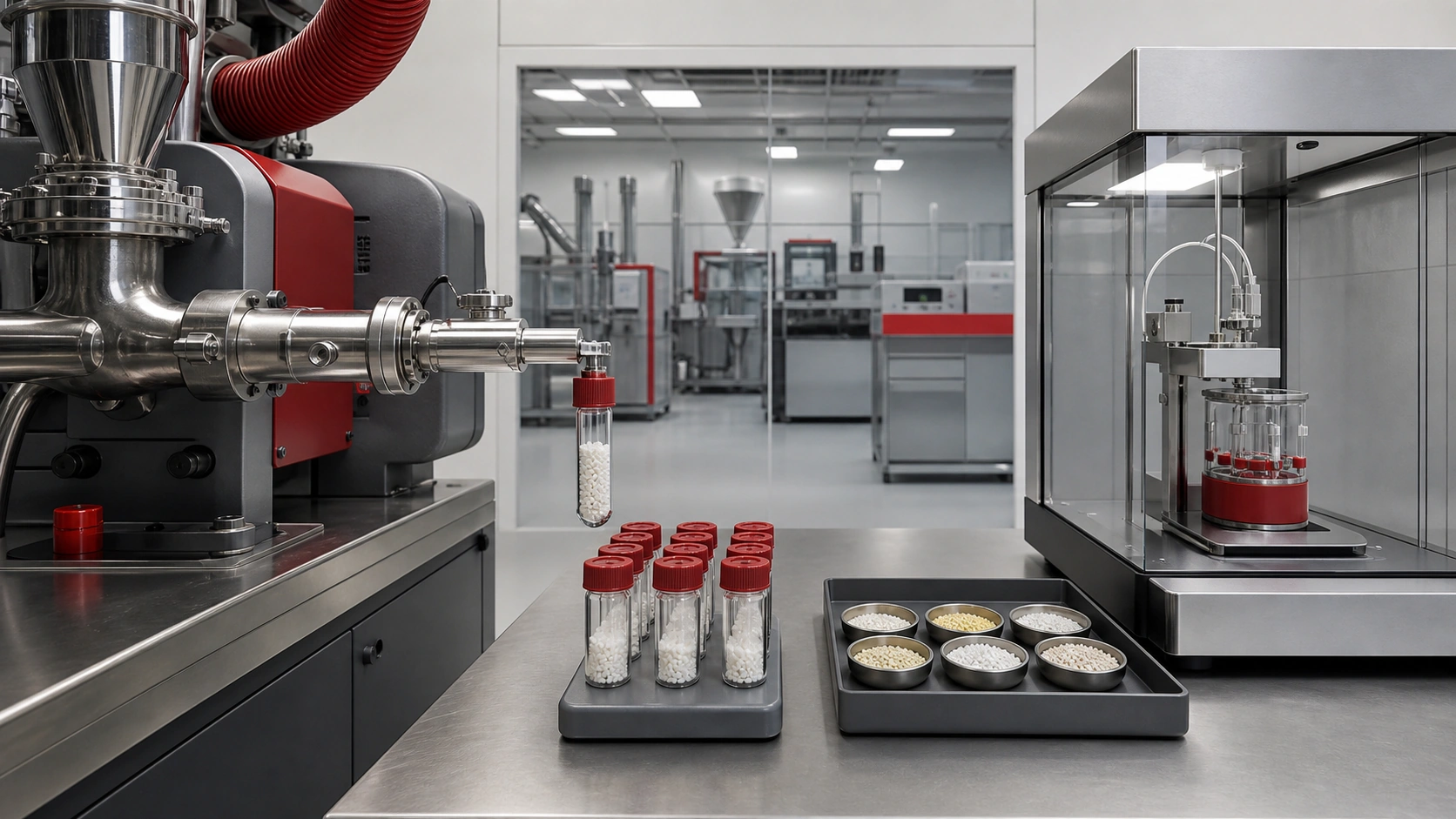
The moisture specification belongs to the resin, so acceptance should use a resin sample. The most representative practical location is the last protected material point before melting, such as the machine hopper or feed-throat supply, after conveying and any waiting period. Sampling only a sealed bag proves incoming condition; sampling only at the dryer outlet can miss reabsorption or transfer problems downstream.
A defensible verification plan contains the following:
-
Record the producer, complete grade, color or additive package, lot, virgin/regrind ratio, and the supplier's current maximum or recommended moisture range.
-
Define the sample location, sampling tool, container, and maximum time between collection and testing. Keep the sample from gaining or losing water while it waits.
-
Use a method fit for the limit and material. ASTM D6869-25 measures water through the Karl Fischer reaction and notes possible interference from volatile components. ASTM D6980-25 measures loss in weight down to its stated range but does not identify which components caused the loss. [6][7]
-
If a shop-floor loss-on-drying method is used, calibrate its temperature and result against a water-specific method for that resin and additive package. Mold release, stabilizer, plasticizer, residual monomer, or another volatile can otherwise be reported as apparent moisture. [6][7]
-
Record the measured value and disposition against the grade specification. A statement that material was “dried for four hours” is a process record, not proof that the acceptance value was reached.
Direct measurement is the key distinction. The Madison Group notes that a low dryer dew-point reading measures the condition of the air and does not guarantee adequate resin moisture; it also explains why Karl Fischer, gravimetric loss-on-drying, and sensor-based methods have different selectivity and detection limits. [8]
Treat Regrind as a Separate Input
Regrind differs from virgin pellets in geometry, handling history, contamination opportunity, and prior heat exposure. More irregular and smaller pieces can change feeding and moisture-exposure behavior, while the first molding pass means the material has already experienced one thermal cycle. Neither fact proves the regrind is unusable, but both make an undocumented blend risky.
Covestro advises applying the relevant virgin-material drying and processing guidance to Makrolon regrind, checking the properties and color of the resulting compound for the application, and establishing the permitted content case by case. [1] That is a better control model than a blanket regrind percentage.
For a moisture-sensitive grade, identify regrind separately, protect it during collection, and verify it to the agreed moisture limit before blending. The moisture result and the maximum number or fraction of heat histories are two different requirements; passing one does not establish the other.
Diagnose the Run Without Blaming the Mold First
| Observation | What it may indicate | Evidence to collect before changing steel |
|---|---|---|
| Silver streaks or bubbles | Moisture or another volatile, but also possible contamination, venting, or thermal damage | Feed-point moisture result, purge comparison, material/lot check, melt temperature, residence time, and defect location |
| Parts look normal but impact or viscosity shifts | Possible molecular-weight loss in a hydrolysis-sensitive resin | Compare retained virgin and processed samples using a material-appropriate viscosity, intrinsic-viscosity, melt-flow, or mechanical test |
| Defects are strongest at startup | Short drying residence, wet transfer line, or material left exposed may be contributing | Hopper inventory/throughput calculation, first-in material condition, transfer path, and timed moisture samples |
| Variation begins after regrind is added | Regrind moisture, contamination, blend ratio, or prior heat history may be involved | Test virgin and regrind separately; verify blender output and approved regrind limit |
| Shot weight or cushion drifts over the run | Feeding or bulk-density change, unstable recovery, transfer-path moisture, regrind ratio, or another process disturbance | Time-ordered part weight, cushion and recovery traces, hopper/throughput record, feed-point moisture, virgin/regrind segregation |
| Weld-line strength falls without an obvious surface change | Hydrolysis or thermal damage may be possible, but venting, meeting angle, pressure, orientation, and contamination remain alternatives | Feed-point moisture, exact resin/lot and process history, weld-line location, paired mechanical tests, vent and fill evidence |
These are hypotheses, not one-observation verdicts. A controlled comparison should change one suspected input while holding the machine, mold, grade, and measurement method stable.
Our manufacturing materials overview and plastic injection molding service provide public starting points for grade and process discussions. Our inspection workflow lists DFM, incoming-material, T1 dimensional, in-process, and pre-shipment checkpoints. For a moisture-sensitive program, add a project-specific feed-point moisture result and retained material sample to the handoff. This addition must be agreed explicitly; the public pages do not state that feed-throat moisture testing is a standard service.
Frequently Asked Questions
Does a -40°C dryer dew point prove the resin is dry?
No. It shows the condition of the drying air at the measurement point. Pellet moisture still depends on grade, temperature, residence time, airflow, starting moisture, hopper behavior, and handling after the dryer. Accept the resin against a direct, grade-specific moisture result.
Can wet molded parts be dried and used again?
Drying may remove absorbed water from a finished part, but it cannot restore molecular weight lost when a hydrolysis-sensitive polymer was melted wet. Material disposition should consider moisture records and property or viscosity evidence, not appearance alone.
Is Karl Fischer always better than loss-on-drying?
Karl Fischer is water-specific, whereas loss-on-drying reports mass lost during heating and may include other volatiles. The appropriate method still depends on the resin, expected range, interferences, calibration, and the controlling specification.
Should POM always be dried?
No. The cited Delrin guide says standard grades generally do not require drying, but it defines exposure conditions that do and gives different instructions for toughened grades. Check the exact producer and grade rather than applying a family-wide rule.
Conclusion
Reliable resin drying in injection molding is an acceptance system, not a dryer setting. Use the exact grade's moisture limit; control dew point, pellet temperature, true residence time, and airflow together; sample at the last controlled point before melting; and choose a moisture method that can resolve the specified limit without misleading interference. If material has already been processed wet, separate a reversible moisture symptom from irreversible molecular-weight loss before deciding to rework, reuse, or scrap it.
Sources
[1] Covestro: Makrolon WB1239 — Water in Good Shape
[2] Eastman: Tritan Renew Processing Guide for Injection Molding Eyewear Frames
[3] BASF: Ultramid B3WG3 BK23274 Processing Data Sheet
[4] Delrin: Technical Molding Guide, 2024
[5] AEC: Why Plastic Resin Is Not Drying Properly — Eight Common Causes
[6] ASTM International: ASTM D6869-25 — Moisture in Plastics Using the Karl Fischer Reaction
[7] ASTM International: ASTM D6980-25 — Moisture in Plastics by Loss in Weight
[8] The Madison Group: Resin Drying — Ensuring Quality in Manufacturing