-q4gvl4k29y4hq8j9rjpapvj0ft06fje63olt7p210i.png "HordRT Logo-2023(red)")

For manufacturers developing new products, rapid tooling offers an ideal balance between speed, cost, and manufacturing flexibility. Compared with conventional production tooling, rapid tooling significantly reduces lead times and initial investment, making it a preferred solution for prototyping, bridge production, and low-volume manufacturing.
However, many companies mistakenly believe that reducing tooling costs simply means obtaining a lower quotation from suppliers. In reality, the true cost of rapid tooling is determined long before machining begins. Product design decisions, mold complexity, material selection, manufacturing methods, and engineering support all have a far greater impact on the final tooling investment than supplier pricing alone.
Attempting to reduce costs by cutting corners can often result in poor quality, repeated mold modifications, production delays, and higher overall project expenses. On the other hand, well-planned engineering decisions can simplify mold construction, reduce machining time, improve manufacturability, and lower tooling costs while maintaining excellent product quality.
This article explains the key factors that influence rapid tooling costs and outlines proven strategies that help manufacturers reduce expenses without compromising performance or reliability.
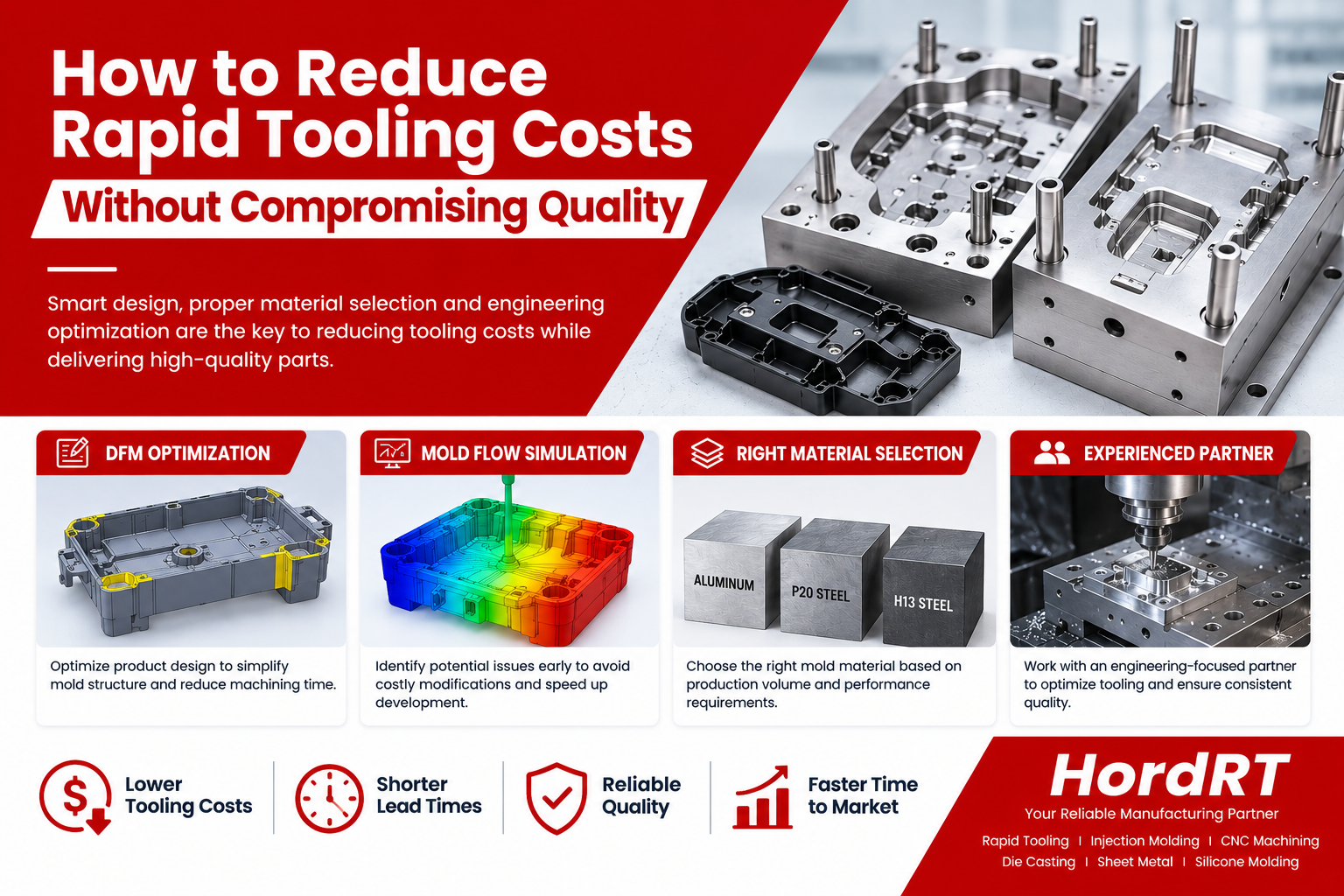
Start Cost Reduction During Product Design
One of the most effective ways to reduce rapid tooling costs is to optimize the product design before mold development starts.
Industry experience consistently shows that the majority of manufacturing costs are determined during the design phase. Once mold machining begins, design changes become increasingly expensive because they often require welding, re-machining, polishing, or even rebuilding portions of the tool.
This is why Design for manufacturing (DFM) analysis plays such an important role in rapid tooling projects.
A comprehensive DFM review evaluates whether a product can be manufactured efficiently while minimizing tooling complexity and production risks.
Typical DFM analysis includes evaluating:
- Wall thickness consistency
- Draft angles
- Rib and boss design
- Gate location
- Parting line placement
- Undercuts
- Ejection methods
- Shrinkage behavior
- Material flow
- Potential sink marks and warpage
Even small design adjustments can produce substantial cost savings.
For example, eliminating an unnecessary side hole or redesigning a snap-fit feature may completely remove the need for expensive side actions inside the mold. Similarly, increasing draft angles by just one or two degrees can simplify ejection, reduce polishing requirements, and extend mold life.
Instead of treating DFM as an optional engineering service, manufacturers should consider it an investment that prevents costly modifications later in the project.
Avoid Overengineering Rapid Tooling
One of the most common mistakes companies make is designing rapid tooling as though it were intended for full-scale mass production.
Production molds are typically built to withstand hundreds of thousands—or even millions —of molding cycles. To achieve this durability, they often incorporate hardened tool steels, sophisticated cooling systems, high-performance hot runner systems, wear-resistant inserts, and premium mold components.
While these features are essential for long-term production, they are often unnecessary for rapid tooling applications.
Rapid tooling is for primarily intended for:
- Functional prototypes
- Product validation
- Market testing
- Bridge production
- Low-volume manufacturing
If a project requires only 500 to 5,000 parts, investing in a mold designed for one million cycles usually provides little economic benefit.
Instead, manufacturers should focus on designing tooling that meets actual production requirements rather than maximum theoretical durability.
An experienced tooling supplier can recommend appropriate mold structures that balance performance, lifespan, lead time,and investment, ensuring customers pay only for the capabilities they truly need.
Selecting the Right Mold Material for Cost Efficiency
Choosing the appropriate mold material is one of the most important decisions in any rapid tooling project. While many customers automatically request hardened steel molds, this approach can significantly increase tooling costs without providing meaningful benefits for prototype or low-volume production.
This ideal mold material depends on the project’s production volume, product requirements, expected tool life, surface finish, and budget—not simply on maximizing durability.
Aluminum tooling
Aluminum tooling has become a popular choice for rapid tooling because it offers excellent machinability and shorter manufacturing lead times. Compared with steel, aluminum is easier to machine, reducing CNC machining hours and overall production costs. It also has superior thermal conductivity, allowing molds to cool more quickly during injection molding, which can shorten cycle times.
For prototype development and low-volume manufacturing, aluminum molds often provide the best balance between cost, speed, and performance.
Typical applications include:
- Product prototypes
- Functional testing
- Design verification
- Market validation
- Low-volume production
Although aluminum molds generally have a shorter service life than steel molds, they can still produce thousands of high-quality parts when properly designed and maintained.
Pre-Hardened Steel Tooling
For projects requiring greater durability, pre-hardened steels such as P20 are widely used.
P20 steel provides a good balance between machining efficiency, wear resistance, and tool life. It is suitable for bridge production and medium-volume manufacturing while remaining more economical than fully hardened tool steels.
Compared with aluminum, P20 tooling requires longer machining time but offers:
- Longer mold life
- Better dimensional stability
- Improved wear resistance
- Higher polishing capability
- Better compatibility with engineering plastics
Hardened Tool Steel
For long-term production involving hundreds of thousands or millions of molding cycles, hardened steels such as H13 or S136 may be the preferred option.
However, these materials involve higher machining costs, longer lead times, and greater initial investment. For most rapid tooling projects, they represent unnecessary overengineering.
The key is selecting a mold material that matches actual production requirements rather tan choosing the strongest material by default.
Rapid Tooling Material Comparison
|
Mold Material |
Initial Cost |
Lead Time |
Tool Life |
Best Application |
|
Aluminum |
Low |
Very Fast |
Low to Medium |
Prototypes, low-volume production |
|
P20 Steel |
Medium |
Moderate |
Medium |
Bridge production, medium-volume manufacturing |
|
Hardened Steel (H13, S136) |
High |
Long |
Very High |
Mass production |
Choosing the right material helps manufacturers avoid paying for unnecessary durability while ensuring reliable part quality throughout the intended production cycle.
Use Mold Flow Simulation to Prevent Expensive Design Changes
One of the most costly problems in tooling development occurs after mold machining has already begun.
If a mold produces short shots, excessive warpage, sink marks, weld lines, or dimensional inaccuracies during the first trial, correcting these issues often requires additional machining, welding, polishing, or insert modifications. In severe cases, sections of the mold may even need to be rebuilt, increasing both cost and lead time.
This is why many experienced manufacturers perform mold flow simulation before cutting steel.
Mold flow analysis uses specialized engineering software to simulate how molten plastic will behave inside the mold cavity before production begins. Rather than relying on trial and error, engineers can identify potential issues digitally and optimize the design in advance.
Typical simulation evaluates:
- Plastic flow patterns
- Gate location
- Fill balance
- Air traps
- Weld line formation
- Pressure distribution
- Cooling efficiency
- Packing performance
- Shrinkage
- Warpage
By addressing these issues early, manufacturers can significantly reduce engineering changes during tooling development.
Although simulation adds engineering work during the design stage, it often saves far more time and money by minimizing mold modifications and reducing the number of trail iterations.
For complex or tight-tolerance components, mold flow simulation is one of the most cost-effective investments a project can make.
Simplify Mold Design Without Affecting Product Performance
Another effective way to reduce rapid tooling costs is to simplify the mold design wherever possible.
Many products are initially designed with features that increase tooling complexity without delivering meaningful functional benefits. Every additional slider, lifter, insert, thread core, or complex shut-off surface increases machining time, assembly effort, maintenance requirements, and overall tooling cost.
Fortunately, many of these features can be redesigned during the DFM stage.
For example:
- Repositioning a side hole may eliminate the need for a slider.
- Adjusting the parting line can simplify mold construction.
- Replacing threaded features with self-tapping screws may remove unscrewing mechanisms.
- Standardizing radii and wall thicknesses can reduce machining complexity.
- Redesigning snap-fit features may eliminate side actions altogether.
These seemingly minor adjustments can substantially reduce tooling costs while maintaining the product’s intended functionality.
The goal is not to simplify the product itself, but rather to simplify the way it is manufactured.
Choose an Engineering-Focused Manufacturing Partner
The expertise of your tooling supplier has a direct impact on both tooling cost and project success.
Some manufacturers simply build molds according to customer drawings. While this approach may appear straightforward, it often misses opportunities to improve manufacturability and reduce unnecessary expenses.
An engineering-focused manufacturing partner takes a different approach. Instead of acting solely as a mold maker, they work collaboratively with customers to optimize both the product and the tooling before production begins.
A capable rapid tooling supplier should provide services such as:
- Design for Manufacturing (DFM) analysis
- Mold flow simulation
- Mold design optimization
- Material selection recommendation
- Tolerance evaluation
- Cost reduction suggestions
- Prototype validation support
- Production planning for future scale-up
This engineering support helps identify potential risks early, reducing design revisions, shortening lead times, and lowering overall project costs.
Rather than selecting a supplier based solely on the lowest quotation, manufacturers should evaluate the supplier’s engineering capabilities, communication efficiency, quality management system, and experience with similar products.
In many cases, a supplier offering strong engineering support can reduce total project costs far more effectively than one offering the lowest initial tooling price.
Balance Initial Tooling Cost With Total Manufacturing Cost
One of the biggest misconceptions in rapid tooling is that the supplier offering the lowest quotation always provides the best value. In reality, the initial tooling price represents only a fraction of the total manufacturing cost over a product’s lifecycle.
A lower-cost mold may appear attractive at the beginning of a project, but hidden costs often emerge during production. Poor mold design, inadequate cooling, or inferior machining quality can lead to frequent maintenance, inconsistent part dimensions, longer cycle times, and higher scrap rates. These issues increase production costs and may delay product launches.
Instead of focusing solely on tooling price, manufacturers should evaluate the total cost of ownership (TCO), including:
- Initial tooling investment
- Mold maintenance and repair
- Cycle time efficiency
- Scrap and rework rates
- Part consistency
- Mold lifespan
- Future production scalability
- Lead time for engineering changes
For example, an aluminum mold may be the most economical option for producing 2,000 prototype parts. However, if the product is expected to transition into high-volume production within a few months, investing in a P20 steel mold from the outset may reduce long-term cost by eliminating the need to build a second tool.
The most cost-effective tooling solution is not necessarily the cheapest one—it is the one that aligns with the product’s development stage, production goals, and future manufacturing plans.
Improve Communication Throughout the Project
Engineering problems are not always caused by poor design. In many rapid tooling projects, unnecessary costs arise simply because critical information is not communicated clearly at the beginning.
When manufacturers receive incomplete or inaccurate project requirements, they may design tooling based on assumptions. As the project progresses, changes to material selection, cosmetic requirements, tolerances, or production volume can require mold modifications, delaying the project and increasing costs.
To avoid these issues, customers should provide as much information as possible before tooling design begins.
Key information includes:
- Expected annual production volume
- Prototype or production objectives
- Plastic material specifications
- Surface finish requirements
- Dimensional tolerances
- Assembly requirements
- Functional testing needs
- Target project timeline
- Budget considerations
Likewise, manufacturers should maintain transparent communication throughout the project by providing DFM reports, mold design reviews, trial reports, and engineering recommendations.
Successful rapid tooling projects are built on collaboration. Early communication minimizes engineering changes, improves decision-making, and helps both parties achieves better results with fewer delays.
Maintain Quality While Reducing Costs
Reducing tooling costs should never mean lowering quality standards.
In fact, the most successful manufacturers achieve cost savings by improving engineering efficiency—not by skipping inspection or using inferior manufacturing processes.
Every rapid tooling project should include a structured quality control process before production begins.
Typical quality activities include:
- Mold component inspection
- CMM dimensional measurement
- Assembly verification
- Mold trial evaluation (T0/T1)
- First Article Inspection (FAI)
- Functional testing
- Cosmetic inspection
- Process validation
These inspections ensure that the mold performs as intended and that molded parts consistently meet customer specifications.
Skipping validation procedures may reduce costs in the short term, but it often results in expensive consequence later, including defective products, production interruptions, customer complaints, warranty claims, and repeated tooling modifications.
A well-designed quality control process protects both the tooling investment and the success of the final product.
Common Mistakes That Increase Rapid Tooling Costs
Even experienced product developers occasionally make decisions that unnecessarily increase tooling expenses. Recognizing these common mistakes can help companies avoid costly engineering changes and improve overall project efficiency.
Designing Unnecessary Undercuts
Undercuts often require sliders or lifters, increasing mold complexity, machining time, and maintenance. Whenever possible, redesigning features to eliminate undercuts can significantly reduce tooling costs.
Specifying Excessively Tight Tolerances
Not every dimension requires ultra-high precision. Applying unnecessarily tight tolerances increases machining time, inspection requirements, and manufacturing costs. Tolerances should be based on functional needs rather than default specifications.
Choosing Premium Tool Steel for Prototype Projects
Selecting hardened steel for a project requiring only a few thousand parts often results in unnecessary expense. Matching mold material to production volume is a more economical approach.
Delaying DFM Analysis
Waiting until after mold machining begins to identify manufacturability issues frequently leads to expensive rework. Conducting a DFM review early in the design process helps eliminate problems before they affect tooling.
Selecting Suppliers Based Only on Price
The lowest quotation may not include engineering support, mold flow analysis, or optimization services. Choosing an experienced supplier with strong engineering capabilities often results in lower overall project costs despite a slightly higher initial quotation.
Avoiding these common mistakes help manufacturers maximize the value of rapid tooling while minimizing unexpected expense throughout the product development cycle.
Conclusion
Reducing rapid tooling costs is not about finding the cheapest mold supplier—it is about making informed engineering decisions throughout the product development process.
From optimizing product design and simplifying mold structures to selecting appropriate tooling materials and performing mold flow simulation, every decision influences the final tooling investment. Companies that prioritize Design for Manufacturing (DFM), effective communication, and engineering collaboration are far more likely to reduce costs without sacrificing product quality or production efficiency.
Rapid tooling is most successful when it is viewed as a strategic investment rather than a simple purchasing decision. By balancing cost, quality, lead time, and future production requirements, manufacturers can accelerate product development while minimizing risk and maximizing return on investment.
Why Choose HordRT for Rapid Tooling?
At HordRT, we specialize in rapid tooling and low-volume manufacturing solutions that help companies bring products to market faster and more cost-effectively.
With over 20 years of tooling and production expertise, our engineering team supports customers throughout the entire product development process—from DFM analysis and mold design optimization to injection molding, CNC machining, quality inspection, and bridge production.
Our capabilities include:
- Rapid tooling for prototype and bridge production
- Plastic injection molding
- CNC machining
- High-pressure die casting
- Sheet metal fabrication
- Silicone compression molding
- Design for Manufacturing (DFM) Support
- Mold flow analysis
- Engineering consultation for cost optimization
Ready to Optimize Your Next Rapid Tooling Project?
Looking for a reliable manufacturing partner that can reduce tooling costs without compromising quality?
Upload you 3D CAD files to HordRT today for a professional DFM review and a competitive rapid tooling quotation. Our experienced engineers will help you identify cost-saving opportunities, optimize manufacturability, and accelerate your path from concept to production.
Frequently Asked Questions (FAQs)
The most effective way to reduce rapid tooling costs is to optimize the product design before tooling begins. Conducting a Design for Manufacturing (DFM) review can eliminate unnecessary complexity, simplify the mold structure, and reduce machining time without affecting the final part’s performance.
Not necessarily. Lower tooling costs do not have to result in lower quality if cost savings come from smarter engineering decisions rather than cutting corners. Optimizing the mold design, selecting the right tooling material, and collaborating with an experienced manufacturer can reduce costs while maintaining dimensional accuracy and production consistency.
Yes. Aluminum tooling is widely used for prototypes and low-volume production because it is faster to machine, offers shorter lead times, and costs less than hardened steel tooling. However, for higher production volumes or abrasive materials, steel tooling may provide better long-term value.
Yes. Rapid tooling is commonly used for bridge production, allowing manufacturers to produce parts while waiting for high-volume production tooling to be completed. This approach shortens time to market and enables early product launches without significant tooling investment.
-2.png)