-q4gvl4k29y4hq8j9rjpapvj0ft06fje63olt7p210i.png "HordRT Logo-2023(red)")

Modern injection mold design requires more than a general-purpose 3D CAD system. Professional mold development involves complex considerations such as parting lines, core and cavity geometry, cooling channel layouts, ejection systems, and gate locations.
A reliable mold design workflow also depends on maintaining associativity between the mold design and the original part model, allowing engineering changes to update automatically without extensive manual rework.
With the increasing adoption of simulation, automation, and digital manufacturing technologies, CAD and CAE solutions have become essential tools for improving mold quality, reducing development time, and optimizing injection molding performance.
This guide compares five widely adopted CAD and CAE software solutions used by professional mold designers and engineers. Rather than presenting a simple ranking, each tool is evaluated based on the applications and design scenarios where it delivers the most value.
Quick Picks: Mold Design Software by Scenario
|
If Your Focus Is |
Start Here |
Why |
|
Large automotive or consumer molds |
Siemens NX |
Class-A surfacing, complex cores, full associativity, dominant in automotive |
|
General-purpose mold design at reasonable cost |
SolidWorks + MoldWorks |
Most widely adopted CAD platform; add-in avoids costly platform switches |
|
Simulation before cutting steel |
Autodesk Moldflow |
Industry standard for fill, pack, cool, and warp analysis across all industries |
|
Aerospace or multi-cavity tooling |
CATIA |
Advanced surface modeling; customer data often arrives in native CATIA format |
|
Lower-cost dedicated mold tooling |
Solid Edge |
Strong mold base libraries at a fraction of NX pricing |
Complete List: Five Tools for Injection Mold Design
|
Tool |
Core Function |
Best For |
Learning Curve |
Mold-Specific Feature |
Industry |
Relative Cost |
|
Siemens NX |
CAD + CAM |
Complex cores, automotive, consumer goods |
Steep |
Mold Wizard: automated parting, core/cavity, cooling |
Automotive, consumer goods, medical |
$$$$$ |
|
SolidWorks + MoldWorks |
CAD + Mold Add-in |
General-purpose mold design |
Moderate |
MoldWorks: Cooling, Runners, Gates, Slides modules |
General manufacturing |
$$$ |
|
Autodesk Moldflow |
CAE (Simulation) |
Flow, cooling, and warp analysis |
Steep |
Fill/pack/cool/warp simulation with material database |
Automotive, electronics, medical |
$$$$ |
|
CATIA |
CAD + CAE |
Aerospace tooling, multi-cavity molds |
Very Steep |
Mold Tooling Designer role, flexible parametric mold design |
Aerospace, automotive |
$$$$$ |
|
Solid Edge |
CAD + Mold Tooling |
Cost-sensitive mold design |
Moderate |
Mold Tooling with DME, Futaba, Hasco mold bases |
General manufacturing, consumer products |
$$ |
Siemens NX. NX Mold Wizard streamlines core and cavity design through automated parting tools, mold design workflows, and standard mold base libraries from suppliers such as DME, HASCO, and Futaba.
SolidWorks with MoldWorks. The MoldWorks add-in turns SolidWorks into a dedicated mold design tool, with modules for cooling, runners, gates, and slides.
Autodesk Moldflow. Moldflow is one of the most widely used injection molding simulation platforms for evaluating part and mold designs before tooling. It analyzes filling, packing, cooling, and warpage behavior to help reduce molding risks.
CATIA. The Mold Tooling Designer role handles surface modeling for complex parting geometries, widely used where customer data arrives in native CATIA format.
Solid Edge. Solid Edge Mold Tooling offers a lower-cost entry with DME, Futaba, Hasco, and Misumi bases.
How to Choose Injection Mold Design Software
Assess simulation needs before CAD decisions. Moldflow compatibility should be considered before committing to a CAD platform if the design workflow depends on flow analysis. Most major CAD platforms can export geometry for simulation, but stronger integration helps reduce data translation issues and improves workflow efficiency.
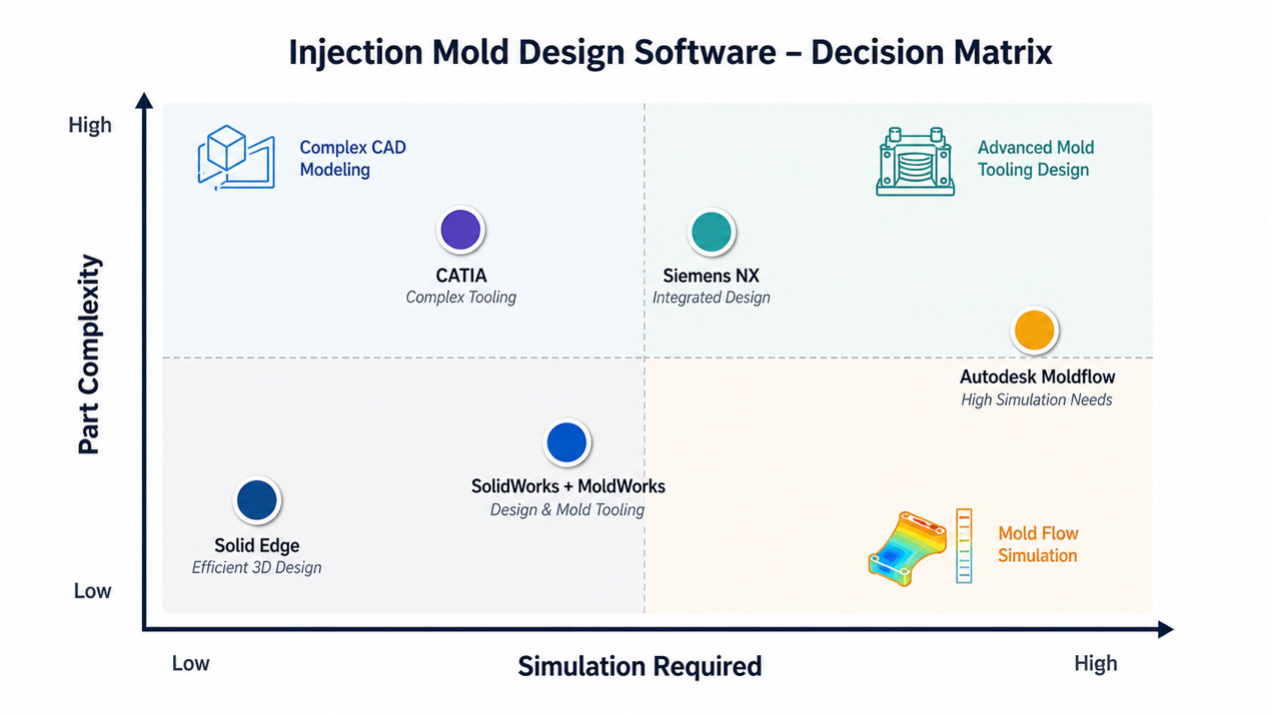
Match the tool to part complexity. Simple two-plate molds for commodity parts do not require NX or CATIA. Complex core actions, slider mechanisms, and multi-cavity layouts with cooling circuit validation benefit from the advanced automation in NX or CATIA.
Check customer file-format expectations. Automotive OEMs and aerospace primes often mandate specific CAD formats in their supplier contracts. If the customer delivers reference geometry in CATIA format, designing the mold in a different platform adds translation risk. Verify format requirements before licensing new software.
Budget for both CAD and simulation. A common mistake is spending the entire tooling budget on a premium CAD license while skipping simulation. The highest-impact investment for a mold design department is often the simulation license, not the fanciest CAD package.
Factor in team training and experience. The best mold design software is the one the team already uses proficiently. Switching platforms requires weeks to months of ramping, so factor that into the cost equation.
Bridging Digital Design and Physical Molds: HordRT
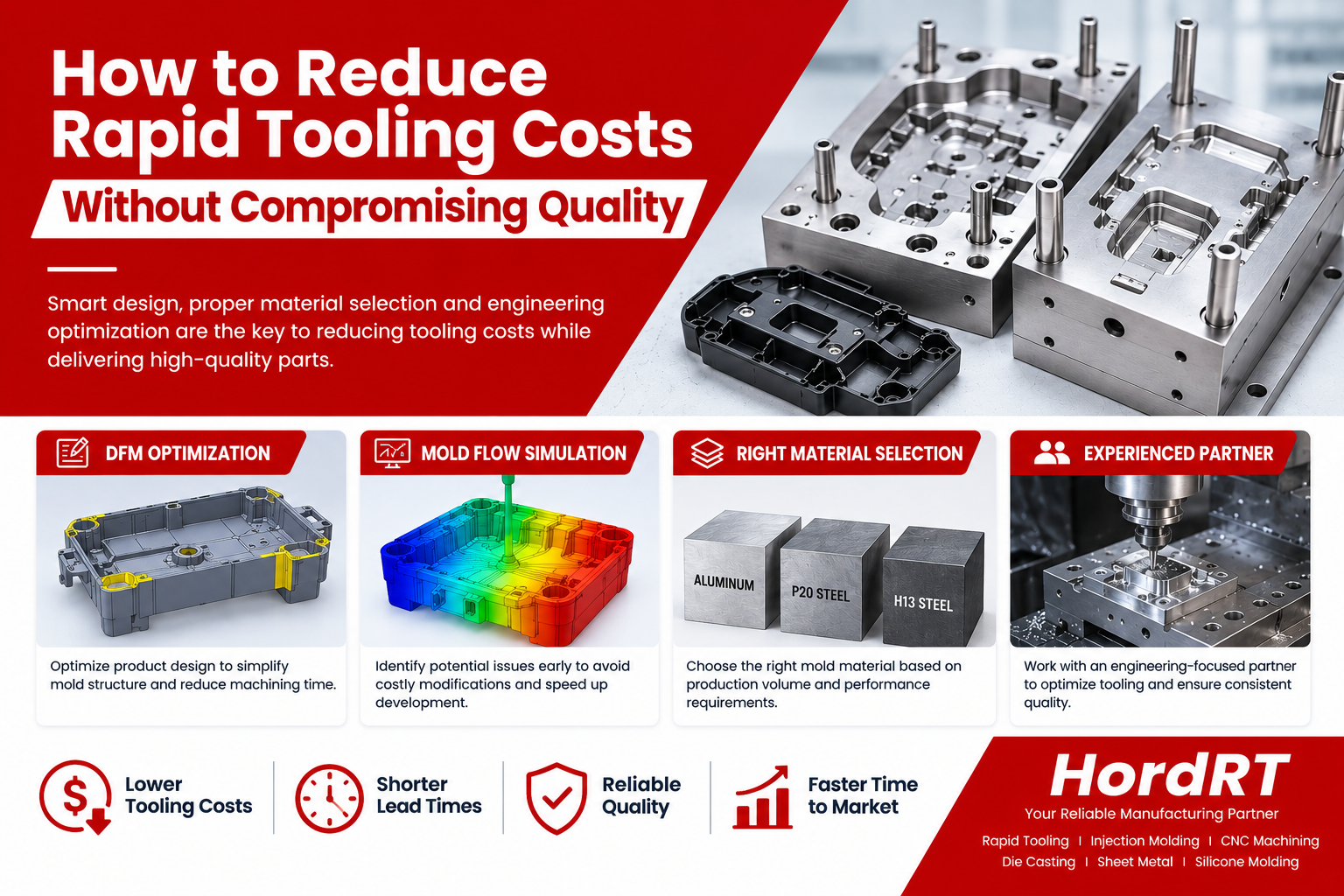
Mold design software produces the blueprint, but the quality of the finished tool depends on how faithfully the digital design is translated into steel and how well the manufacturing process accounts for real-world material behavior. HordRT, an ISO 9001 and IATF 16949 certified manufacturer with over 13 years of experience.
The company works with customer CAD data from major platforms and common file formats, including STEP, IGES, STL, and native CAD files, while providing professional Design for Manufacturing (DFM) analysis to identify potential molding risks before tooling begins. The DFM review examines draft angles, wall thickness uniformity, gate placement, and other factors that affect moldability before any steel is cut. With no minimum order quantity and typical lead times of 10–15 days, supporting projects from prototype tooling to production, HordRT offers rapid tooling solutions with SPI mold classifications 101–105 available and typical rapid tooling lead times as fast as 10–15 days, depending on project complexity.
Frequently Asked Questions
Do I need Moldflow if I already have CAD?
The short answer is yes for any mold with complex geometry, tight tolerances, or expensive tooling. CAD tells you where the steel goes. Moldflow tells you whether the plastic will fill, pack, and cool correctly before you cut that steel. The simulation cost is typically a fraction of a single tooling revision.
What is the minimum software for professional mold design?
For many small-to-medium mold design teams, SolidWorks combined with a mold design add-in such as MoldWorks can provide a practical professional workflow. While SolidWorks is a capable general-purpose CAD platform, dedicated mold design tools add features such as core and cavity creation, mold base selection, cooling layouts, runners, and slide design.
Why choose NX over SolidWorks for mold design?
NX provides deeper automation for complex molds, particularly for multi-cavity layouts, family molds, and components requiring Class-A surface finishes. The associativity between the part model and all downstream tooling elements is more complete. The trade-off is higher per-seat cost and a steeper learning curve.
Final Verdict
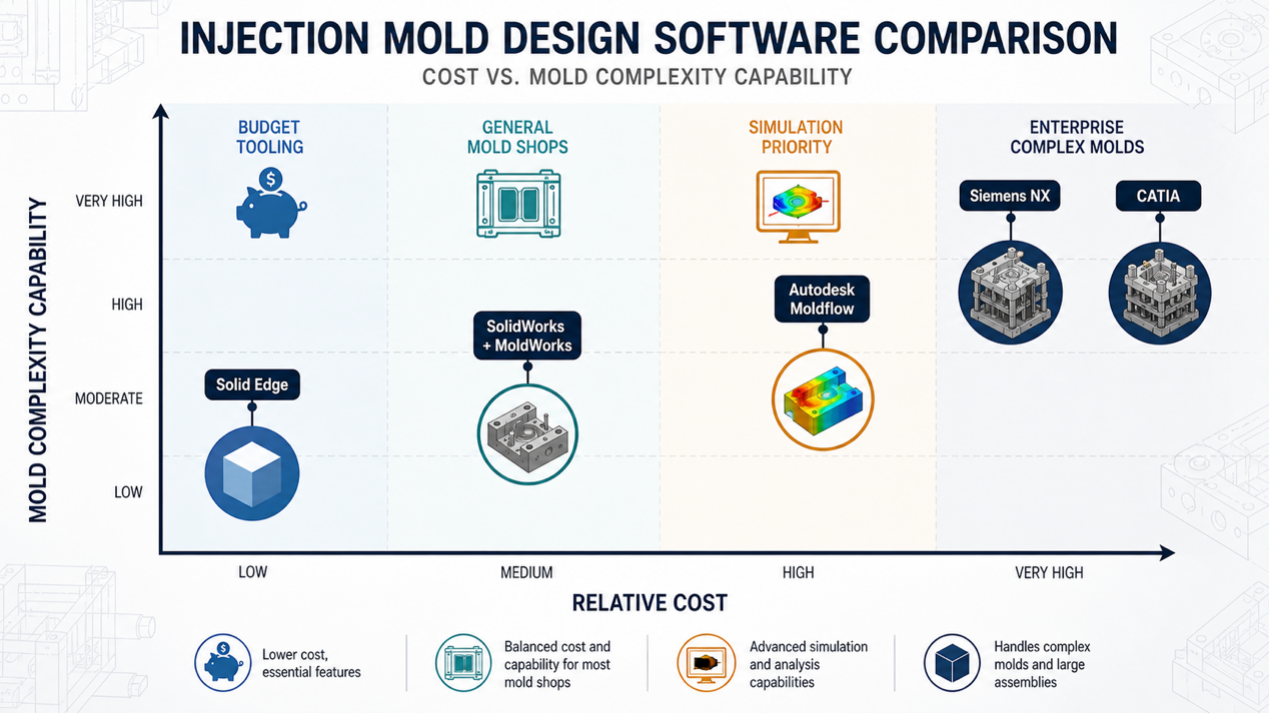
No single software package is the best choice for every mold design scenario. SolidWorks with MoldWorks offers the most versatile and widely adopted combination for general-purpose mold design, covering the broadest range of shops and part types at a reasonable cost. When part complexity, surface finish requirements, or customer mandates demand it, NX or CATIA provide the advanced surfacing and automation that justify their premium pricing. Regardless of the CAD platform chosen, a Moldflow or equivalent simulation capability should be part of every mold design workflow. It is the single highest-ROI investment available.
The common thread across all five tools: mold design software is an enabler, not a substitute for DFM discipline. The most expensive CAD seat cannot compensate for a design with inadequate draft, non-uniform wall thickness, or poorly placed gates. Validate the design digitally, then partner with a manufacturer like HordRT that performs its own DFM review before cutting steel.
Sources
- Business Research Insights. "Injection Molding Software Market Size, Share & Outlook to 2035." BRI. https://www.businessresearchinsights.com/market-reports/injection-molding-software-market-108852
-2.png)