Johnny Xiong
Rapid Tooling Expert
Contents
Liquid Silicone Rubber (LSR) injection molding is a high-precision, highly automated manufacturing process built for producing complex silicone parts at medium to high volumes. This article explains how the process works, compares LSR with HCR compression molding, and outlines key design considerations, applications, and market trends.
What Is LSR (Liquid Silicone Rubber)?
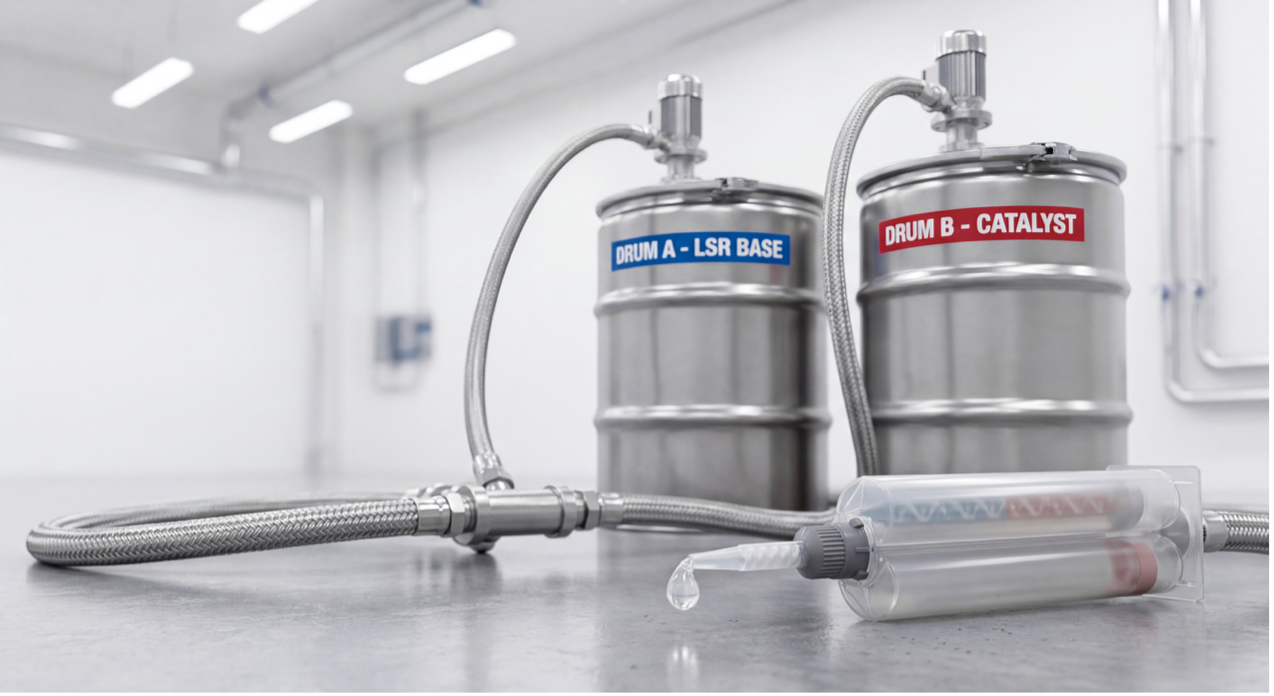
LSR is a two-component, platinum-catalyzed silicone elastomer. Part A contains the platinum catalyst; Part B contains the cross-linker (methyl hydrogen siloxane) and an inhibitor. The two components are stored separately and mixed at a precise 1:1 ratio immediately before injection.
The resulting material has a set of properties that make it suitable for demanding applications: biocompatibility (meeting ISO 10993 and USP Class VI), thermal stability across a continuous operating range of -50°C to +200°C, optical clarity in certain formulations, and resistance to a broad range of chemicals including alcohols, dilute acids, and body fluids.
The global LSR market was valued at approximately USD 3.2 to 3.4 billion in 2025, and is projected to reach USD 6.5 to 7.6 billion by 2033 to 2035, growing at a CAGR of 8% to 9.1%. Medical-grade LSR accounts for roughly 44% of total market revenue by product grade, driven by strict regulatory requirements for biocompatible materials in patient-contact devices.
How LSR Injection Molding Works
The process follows a closed-loop, automated sequence:
Metering and mixing. Precision pumps draw Part A and Part B from sealed drums and deliver them to a static or dynamic mixer. The mix ratio is tightly controlled because even small deviations affect cure speed and final properties.
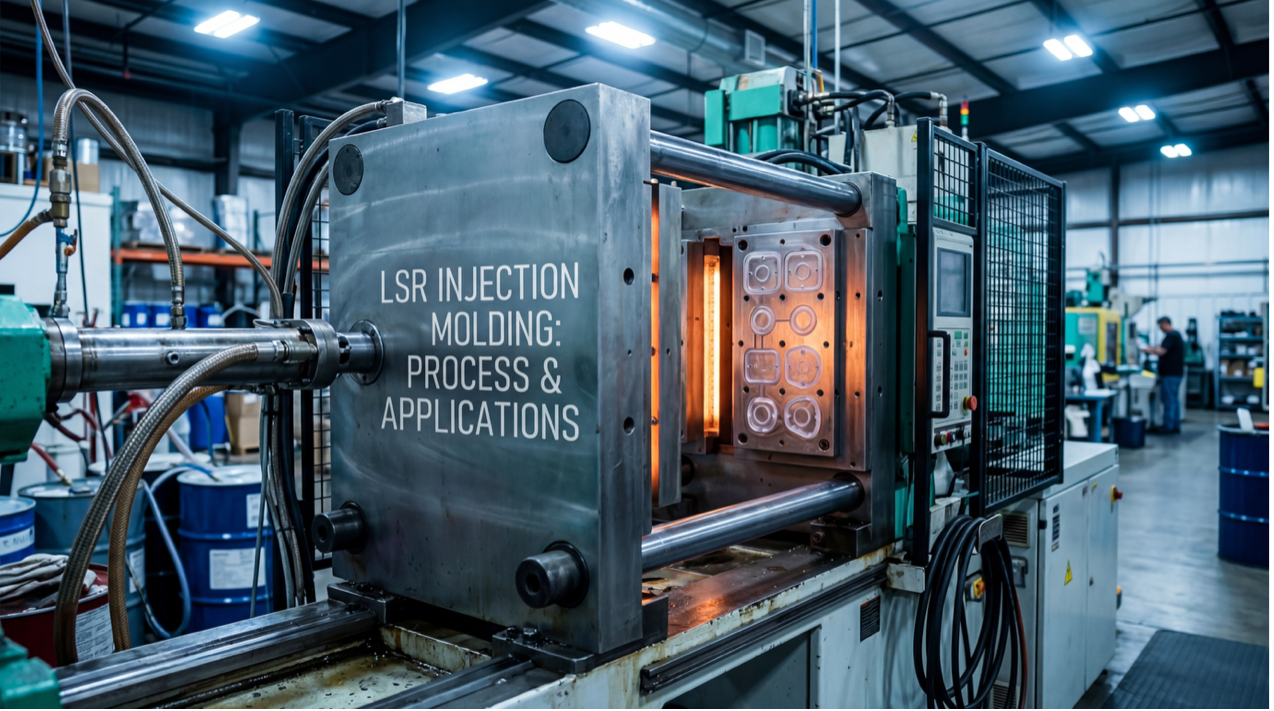
Injection into a heated mold. Unlike thermoplastic injection molding, where the mold is cooled to solidify the part, an LSR mold is heated to 170°C to 200°C to initiate vulcanization. The mixed LSR is kept cool in the barrel and injected through a cold runner system into the hot mold cavities.
Vulcanization. The platinum-catalyzed cross-linking reaction converts the liquid into a solid elastomer. Cycle times range from 30 seconds to 180 seconds depending on part wall thickness and geometry. A common industry benchmark is 4 to 6 seconds of cure time per millimeter of wall thickness.
Demolding. Cured parts are ejected automatically or with air assistance. LSR's natural release properties often eliminate the need for external mold release agents, which reduces contamination risk in medical and food-contact applications.
Cold runner systems are the standard for production LSR molds. A cold runner uses shut-off valves (also called needle valves) to seal each gate between shots, preventing premature cure in the runner and eliminating material waste.
Open-tip cold runners are a lower-cost alternative, where a small plug of cured silicone seals the tip between cycles and is pushed into the cavity at the start of each new shot.
LSR vs HCR: When to Use Each
LSR and HCR are both silicone elastomers, but their processing characteristics and cost structures differ significantly.
Viscosity and processing. LSR is a low-viscosity liquid that flows readily into thin walls and fine details. HCR is a high-viscosity, gum-like solid that requires manual loading into open molds or feeding into extruders.
Tolerances. LSR injection molding achieves tolerances of ±0.05 mm to ±0.10 mm under optimized conditions. HCR compression molding typically holds ±0.20 mm to ±0.50 mm.
Cycle time. LSR cycles are measured in seconds to low minutes (30 to 180 seconds). HCR compression cycles run 3 to 10 minutes.
Tooling cost. LSR molds require precision steel tooling with flash gaps below 0.005 mm (0.0002 in.) to prevent the low-viscosity liquid from leaking. This makes LSR molds more expensive to build than compression molds, which are simpler in construction.
Volume sweet spot. HCR compression molding is more cost-effective for runs under approximately 10,000 units per year due to lower tooling investment. LSR injection becomes the more economical choice above 10,000 units, and its per-part cost advantage grows significantly above 50,000 units as automation reduces labor.
Material waste. Cold runner LSR systems produce near-zero material waste because uncured material in the runner is recycled into the next shot. HCR compression molding generates flash waste of 2% to 5% of part weight.
Design Considerations for LSR Parts
Wall Thickness
LSR fills thin walls more easily than any thermoplastic, because it flows as a true liquid before curing. Walls as thin as 0.2 mm are achievable in small areas, and 0.3 mm is practical for larger surfaces. The recommended range for most production parts is 0.5 mm to 10 mm. Unlike thermoplastics, LSR does not exhibit sink marks, so moderate wall thickness variation is acceptable.
Self-Sealing Parting Lines
Because LSR flashes at gaps as small as 0.005 mm, mold halves must be machined to extremely tight flatness. The benefit of this precision is that properly built LSR molds produce near-flash-free parts, eliminating most secondary trimming operations.
LSR Overmolding with Thermoplastics
LSR overmolding bonds silicone directly onto thermoplastic substrates (such as PA, PBT, or PC) in a two-shot or insert-molding process. The LSR cures and bonds to the substrate in the mold, creating an integrated soft-touch grip, seal, or dampening element. Gate and runner design for overmolding requires careful attention to avoid washing the substrate or creating uneven flow.
Shrinkage
LSR shrinkage ranges from 2% to 3%, similar to HCR silicone. Because shrinkage prediction is complex and depends on mold temperature, cavity pressure, and material grade, prototype tooling and dimensional sampling are standard steps before committing to production tooling.
Key Applications
LSR injection molding is used across industries that require precision, cleanliness, and biocompatibility.
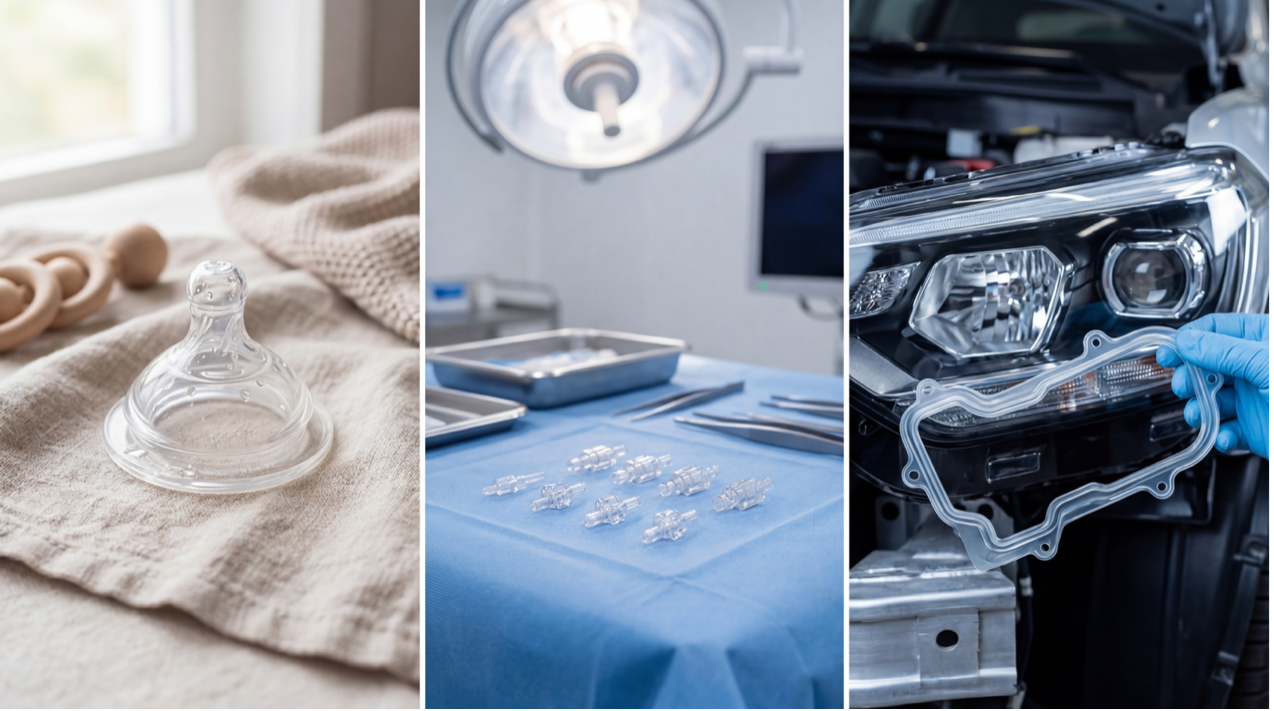
Baby products: Bottle nipples, pacifiers, and teething rings are among the highest-volume LSR applications. The material's purity, transparency, and compliance with food-contact regulations make it the standard choice.
Medical devices: Catheters, respiratory mask cushions, syringe plungers, implantable seals, and drug-delivery valve components all rely on LSR for its biocompatibility and dimensional consistency across millions of units.
Automotive: Connector seals, sensor housings, LED headlamp gaskets, and vibration-dampening components use LSR for its temperature stability and resistance to automotive fluids.
Consumer electronics: Waterproof seals for smartphones, wearable device bands, and silicone keypads benefit from LSR's ability to reproduce fine surface textures and tight tolerances.
LED optics: Certain optically clear LSR grades are used to mold lenses and light guides for LED lighting systems, replacing traditional polycarbonate or PMMA in applications that require high heat resistance.
Getting Started with HordRT
HordRT supports silicone projects from prototype through production. Our engineering team provides DFM analysis at the quotation stage, and our in-house mold shop builds both compression and injection tooling with typical lead times of 2 to 3 weeks for rapid tooling. We hold ISO 9001 and IATF 16949 certifications. No minimum order quantity is required.
Whether your project calls for a 50-piece prototype run or a 100,000-unit production campaign, get in touch with HordRT to discuss material selection, mold design, and pricing.