-q4gvl4k29y4hq8j9rjpapvj0ft06fje63olt7p210i.png "HordRT Logo-2023(red)")

Johnny Xiong
Rapid Tooling Expert
Contents
In the high-stakes world of plastic injection molding, your tooling is arguably your most valuable asset. It is the heart of the manufacturing process—a complex assembly of precision-machined steel designed to operate under immense pressure and fluctuating thermal conditions. However, even the highest quality Class 101 molds are subject to the laws of physics. Over time, abrasive resins, thermal cycling, and mechanical stress inevitably lead to wear.
At this critical juncture, procurement teams and engineers face a common dilemma: Do we invest in mold refurbishment, or is it time to commission entirely new tooling?
At HordRT, we guide clients through this decision daily. The choice is rarely straightforward; it requires a multi-dimensional analysis of Total Cost of Ownership (TCO), market-driven lead times, and the mechanical stability of the tool. In this guide, we break down the financial and technical realities of mold refurbishment versus replacement to help you make the most profitable decision for your production line.
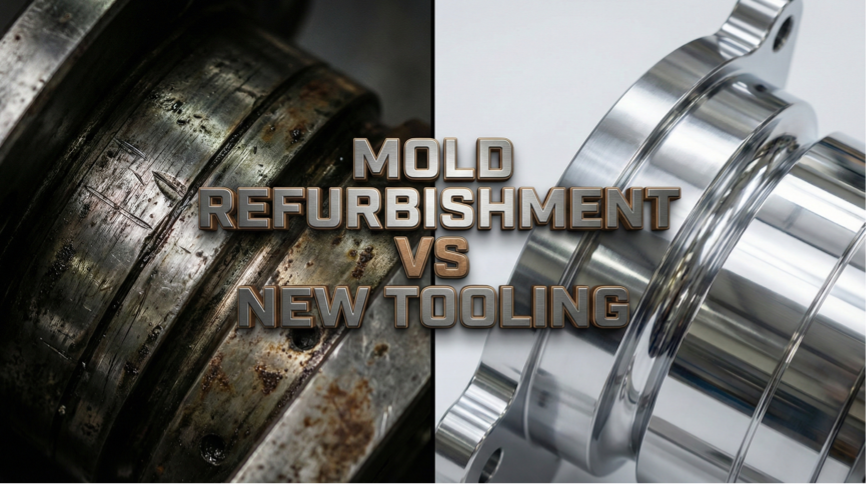
What Is Mold Refurbishment?
To make an informed decision, we must first define our terms. In the industrial hierarchy of tool maintenance, mold refurbishment occupies the middle ground between localized mold repair and full replacement.
While a "repair" is generally reactive—fixing a specific failure point like a broken ejector pin or a seized slider—injection mold refurbishment is a holistic, systematic approach. It aims to restore the mold as close to its original OEM specifications as possible.
Refurbishment is not a patch-up job; it is a revitalization process. It typically involves:
- Disassembling the entire tool.
- Deep cleaning all components, including cooling channels (often clogged with scale or rust).
- Replacing all consumable wear components (bushings, pins, O-rings).
- Restoring parting lines and shut-off surfaces to eliminate flash.
- Re-polishing cavities to meet the original SPI surface finish standards.
Think of it as an engine overhaul rather than a simple oil change. The goal is to extend the tool's service life for another significant production run, ensuring consistent part quality without the capital expenditure of a new build.
Common Issues That Require Mold Refurbishment
How do you know when mold maintenance is no longer enough and refurbishment is required? At HordRT, we advise our clients to monitor their output for three specific "symptoms" that indicate a mold is losing its integrity.
- Excessive Flash and Parting Line Wear
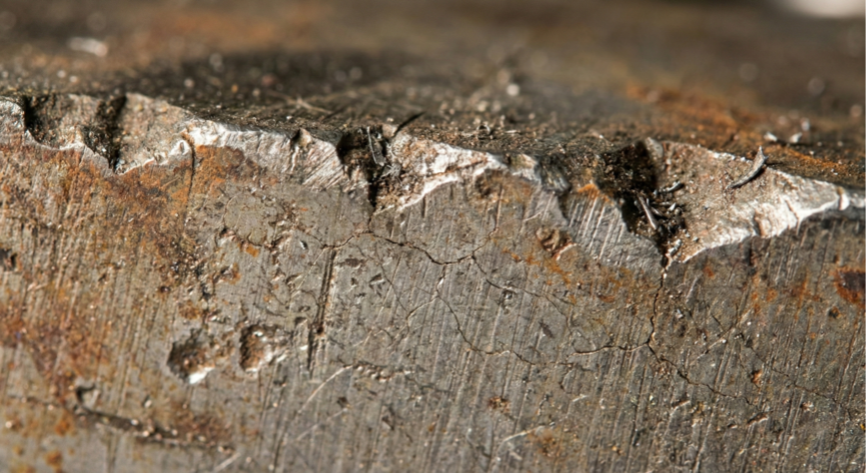
The most obvious sign of a tired mold is flash—excess plastic seeping out between the mold halves. This usually signals that the parting lines or shut-off surfaces have worn down or deformed due to repeated clamping pressure. While process engineers can temporarily mask this by adjusting clamping force, it eventually leads to tool damage. Refurbishment involves welding and CNC re-machining these surfaces to restore a hermetic seal.
- Dimensional Drift
When parts start failing Quality Control (QC) checks due to size variances, the mold is often the culprit. Abrasive materials (like glass-filled nylon) act like sandpaper, slowly eroding the cavity steel. This leads to "dimensional drift," where parts become slightly larger or lose critical tolerances.
- Surface Finish Degradation
For cosmetic parts, appearance is everything. Over thousands of cycles, the mold surface can develop drag marks, scratches, or "orange peel" textures due to heat and chemical off-gassing. If your high-gloss parts are coming out dull, the mold cavity requires professional polishing to restore the texture or mirror finish.
Mold Refurbishment vs. Building a New Mold
This is the core of the strategic decision. When we compare mold refurbishment against building new tooling, we analyze three pillars: Cost, Lead Time, and Performance.
- Cost Comparison
From a financial perspective, refurbishment is almost always the clear winner.
- Refurbishment Costs: Typically range from 15% to 40% of the price of a new mold. You are leveraging the existing mold base (which is often 30-50% of the tool's value) and hot runner systems, paying only for the labor and machining needed to restore the core and cavity inserts.
- New Tooling Costs: Requires paying for fresh steel, full design engineering, and complete manufacturing. For complex multi-cavity tools, this is a significant Capital Expenditure (CAPEX).
- Lead Time Comparison
In today’s "on-demand" manufacturing environment, time is often more expensive than steel.
- New Tooling: Building a production-grade mold from scratch typically takes 8 to 14 weeks, depending on complexity. This does not include the time for T1 sampling and texture approval.
- Refurbishment: A comprehensive refurbishment at HordRT can often be completed in 1 to 3 weeks.
For a product launch or a running production line, saving two months of downtime can save millions in potential lost revenue.
- Performance Considerations
A new mold guarantees 100% life expectancy. A refurbished mold generally offers 70-90% of the performance of a new tool. If the steel hardness has not been compromised, a refurbished mold can run reliably for hundreds of thousands of additional cycles. However, if the tool has been refurbished multiple times previously, the "law of diminishing returns" applies.
When Mold Repair Is Not Recommended
Despite our expertise in restoration, HordRT engineers value transparency. There are scenarios where refurbishment is throwing good money after bad. We recommend investing in new tooling under the following conditions:
- Catastrophic Structural Damage
If the mold base (the frame holding the cavities) is cracked due to fatigue or excessive clamping force, the safety of the tool is compromised. Welding a cracked mold base is rarely a long-term solution. Once the structural integrity of the frame is gone, a new tool is mandatory for safety and precision.
- Design Obsolescence
If your product design has undergone significant revisions, trying to modify an old mold to fit a new design is often more expensive than building new. "Frankenstein" molds—tools that have been welded and cut repeatedly to accommodate design changes—often suffer from cooling inefficiencies and higher scrap rates.
- Cooling System Failure
If the cooling channels are rusted through or blocked to the point where cycle times have doubled, refurbishment is difficult. While we can drill out channels, severe internal corrosion often warrants a new build to utilize modern conformal cooling technologies for better efficiency.
Mold Refurbishment Services at HordRT
At HordRT, we are not just a machine shop; we are a comprehensive manufacturing solutions provider. We understand that your goal isn't just to "fix a tool," but to resume production of high-quality parts.
Our mold refurbishment services leverage our advanced in-house capabilities:
Precision CNC Re-Machining
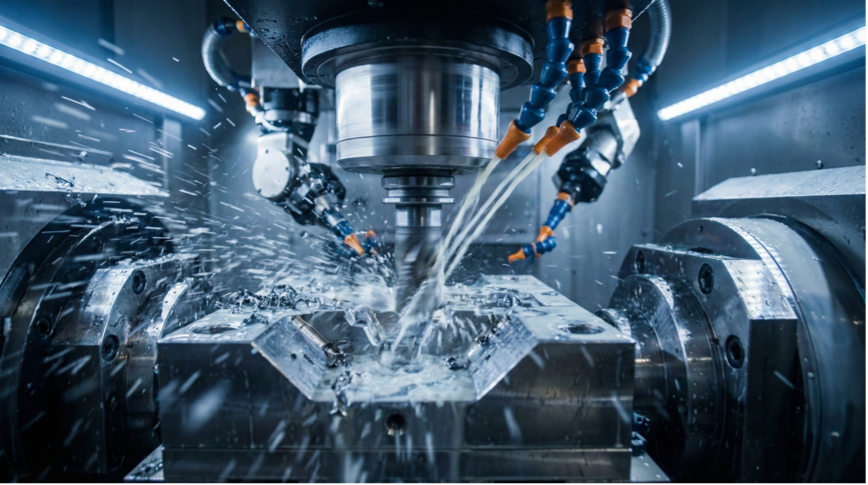
When restoring parting lines or shutting-off surfaces, manual repair isn't enough. We utilize our high-speed CNC machining centers to re-cut steel surfaces with micron-level precision. This ensures that when the mold is reassembled, the flash is eliminated, and the dimensions are spot-on.
Expert Surface Treatment and Polishing
Our facility is equipped with dedicated polishing stations where skilled technicians restore SPI finishes. Whether you need a diamond polish for optical clarity or a specific texture for grip, we can revitalize the mold surface to ensure cosmetic perfection.
The HordRT Advantage
We treat client molds with the same care as the tools we build ourselves. Whether you are looking to extend the life of a legacy mold or need emergency mold repair to get a line back up and running, our team is ready to assist.
Don't let worn tooling eat into your profit margins.
Is your production line suffering from flash, rejects, or slow cycle times? Contact HordRT today for a comprehensive mold evaluation. Let us help you decide whether to refurbish or replace, ensuring you get the best performance for your budget.
-2.png)